I built a system that should have printed money.
The idea was simple. Existing customers already trusted the company. We would offer them more of what they had already bought, at a price designed to make the decision easy.
It took me about a month to build. Then I handed it over.
Four months passed. Nothing. Not a no. Just a soft, “Let’s look at this once we’ve built the other thing.”
The other thing never got built.
I ran the numbers later, partly out of frustration and partly because I needed to know whether I had imagined its potential. Properly deployed, I estimated it could have brought in somewhere between fifty and a hundred thousand dollars.
Instead, it sat in a drawer.
I told myself it was timing. I told myself the company had other priorities. I did not tell myself that I had built something valuable inside a business I did not own.
I understood the system. I could explain why I thought it would work. But that did not give me the authority to deploy it or a share in what it might produce. And because it was never deployed, the revenue I estimated remains just that: an estimate.
So I stayed. I kept showing up. I was good at the work behind the scenes, and I liked being good at it. I told myself that invisibility was simply part of the job.
Years later, at a different company, I made a similar mistake with more time attached to it.
I joined early, on the understanding that if I helped build the company, partnership would follow when we had proved the model. Nothing was guaranteed in writing, but it felt solid enough to build years on.
I created the delivery system that got the product into customers’ hands. I helped turn a community into revenue. I was responsible for making sure what had been promised actually got delivered.
Four years passed. Then came the call.
A message arrived first, telling me the conversation was coming. I sat at my desk and tried to work while I waited, although half my attention had already left the room.
When the number came, it was somewhere between one and four per cent.
Given the time and the work I had put in, I would have considered twenty to thirty per cent fair. What I was offered told me how differently the other side valued my contribution.
I had understood the business so completely that it had started to feel like mine. But responsibility was not ownership. Neither was proximity to the person who owned it.
Work and building are not the same thing
Work produces an immediate result. A client gets served. A deadline gets met. A company earns money. Everyone moves on to the next thing.
Building leaves something behind: a skill you can apply again, a process you control, a reputation attached to your own work, relationships you are entitled to maintain, proof that strengthens an offer, or capital that creates options.
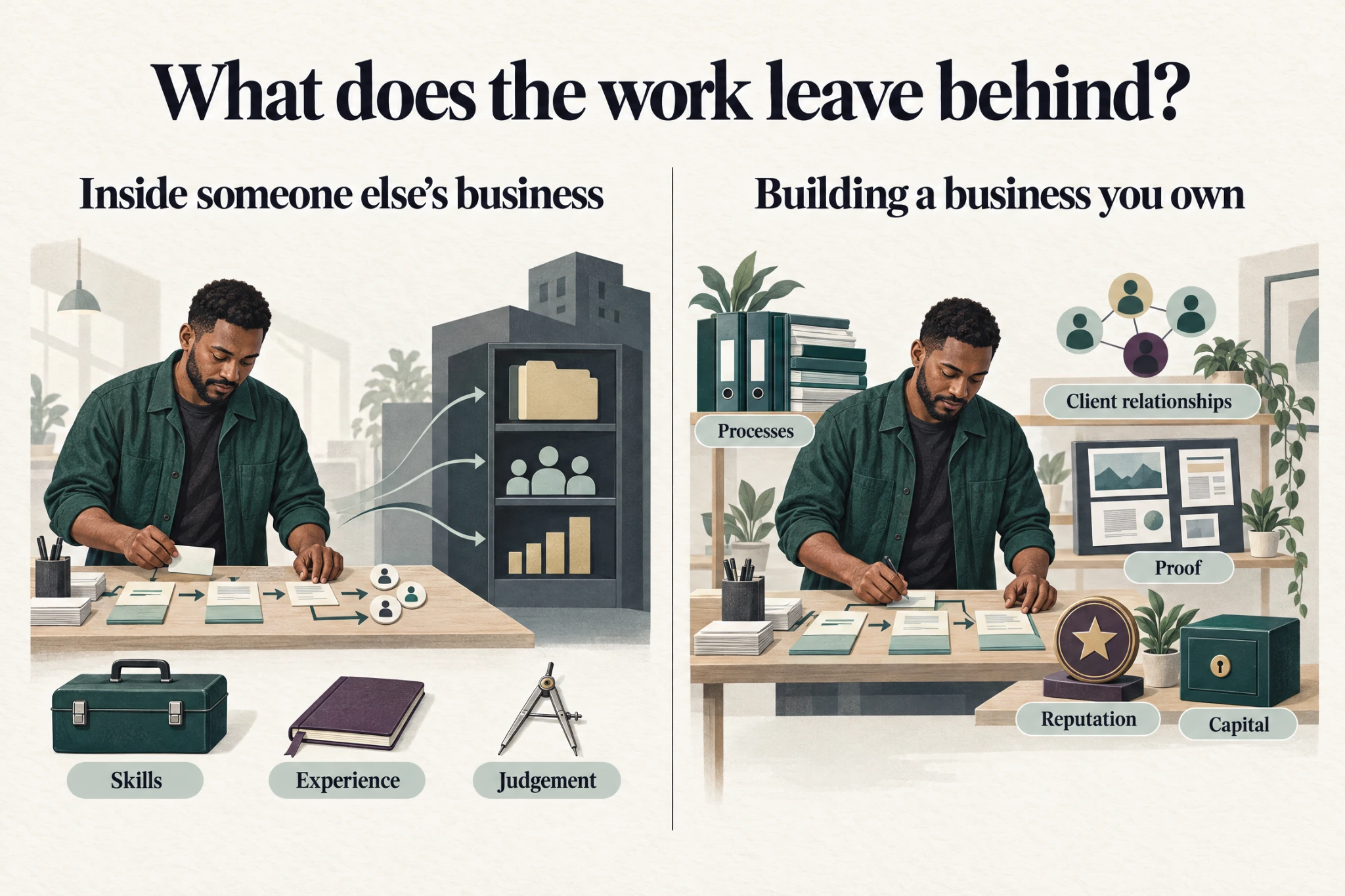
Working for someone else can develop your capability. Building your own business gives you a place to turn that capability into assets you control. Those assets still have to be built.
This does not mean employment is pointless. Nor does it mean a company’s customers, systems or intellectual property become yours because you worked on them.
It means that whatever work you choose to do, some portion of your effort ought to strengthen something you can legitimately carry forward.
Many capable people are willing to work hard. What frightens them is the possibility of doing it for five or ten years and finding that surprisingly little of the value they created can come with them.
They gained responsibilities they did not control. They improved systems they did not own. They built a reputation known chiefly inside someone else’s organisation. They worked. They may have done brilliant work. But much of what their effort built stayed behind.
That was the part I had to face.
The problem was never that I liked working behind the scenes. I like understanding how the pieces fit, finding what is broken and building what makes an outcome possible.
The name for the business I wanted to build comes from the orchestra.
The conductor directs the orchestra. First chair leads an instrument section. Second chair is a skilled position within that section, contributing to the performance without needing to be the soloist.
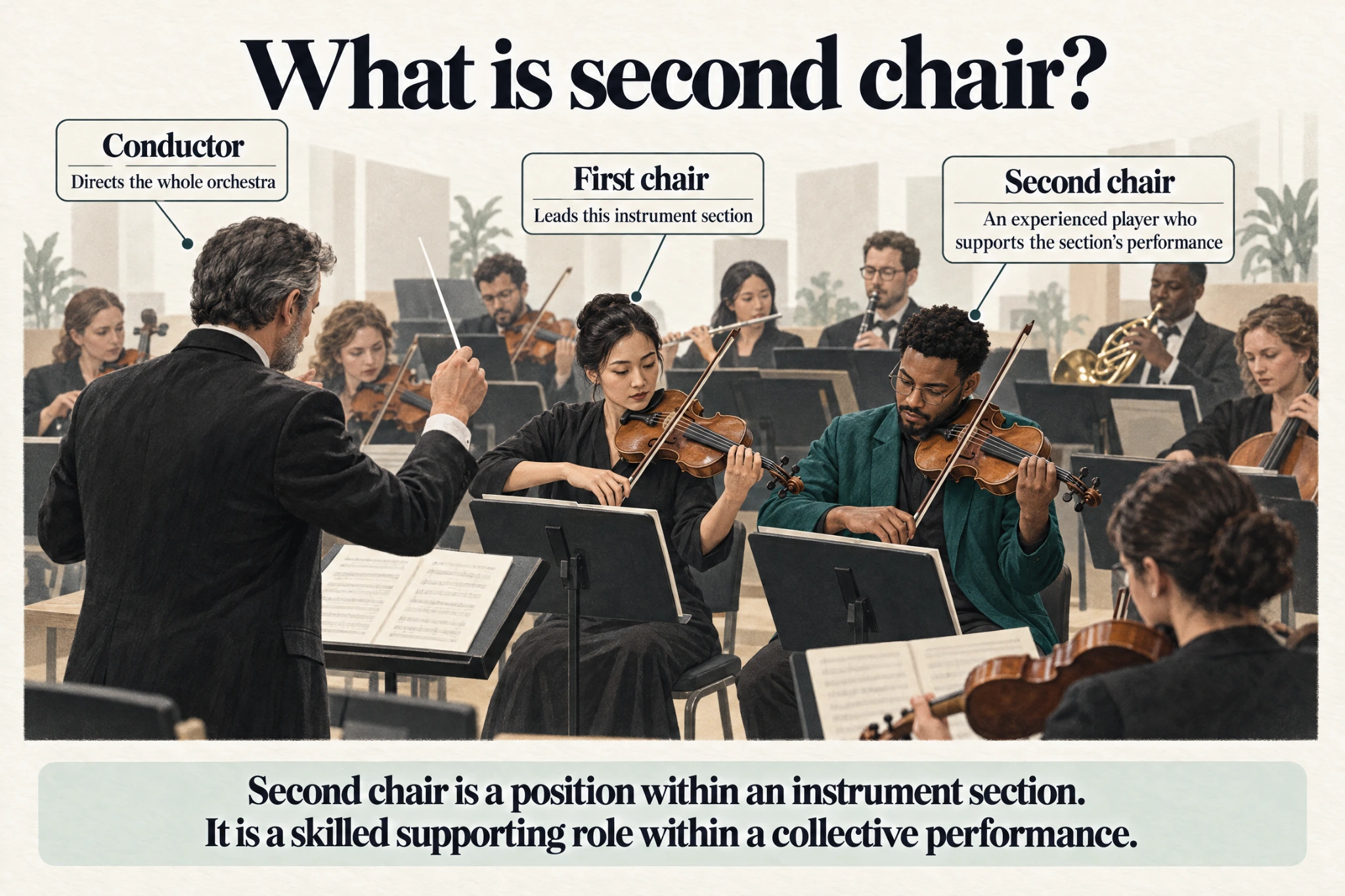
The musical role is the starting point for the metaphor. BYOB takes it further: turn the skills you use to support others into a business you own and lead.
The problem was that I kept playing second chair in someone else’s orchestra. I helped make the music. I did not own the business around it.
I wanted to use those skills to build an operation of my own. I could still do the work, but I would also choose its direction, build the team and take responsibility for the result.
That is the question underneath BYOB:
How do you keep doing the kind of work you are good at while making sure that work leaves you with something you own?
For years, the internet has offered one answer: become the face. Build a personal brand. Post every day. Turn your personality into the marketing.
But what if you want to own the business without becoming its main product?